


 All Post
Case Study: How Public Image uses Publytics to track AI visits, Google traffic, and real-time SEO signals
Jul 06, 2026 | Author: Anna Battistella
How a modern SEO agency bypassed GA4 complexity to turn fragmented search data into fast marketing decisions.
TL;DR: The Public Image story with Publytics
- Company: Public Image, a digital marketing and SEO agency specialised in Google and AI.
- Business model: SEO consulting, digital marketing services, Google visibility, and AI-oriented search strategy.
- Previous challenge: Reading traffic sources, AI-related visits, and page-level engagement clearly enough for fast SEO decisions.
- Why GA4 was not enough: The team needed a more readable workflow for source-level traffic, real-time activity, and emerging AI referrals without turning every report into a technical investigation.
- Why Publytics: Real-time reporting, clear source attribution, AI traffic tracking, and page-level engagement data in one practical analytics environment.
- The result: A clearer way to separate Google traffic, AI-related visits, referral patterns, and high-engagement service pages, giving the team a stronger basis for SEO and content decisions.
The company: A Google and AI-focused agency built around search visibility
Public Image is a digital marketing and SEO agency focused on Google visibility, organic strategy, paid search and on the way AI tools are starting to reshape search behaviour. Because the entire business is about advising clients on how to grow through search, analytics sits underneath almost every decision the team makes: what content to update, which service pages to sharpen, how to plan campaigns and where the next visibility opportunity might be.
All of that depends on reading attention accurately. When Google, AI tools, referral sources and unlabelled traffic feed the same dashboard, the team needs analytics that answers questions rather than raising new ones.
- Aleksandar Ivanišević, SEO Specialist and CEO at Public Image
"For an SEO agency, the challenge is to understand where attention is really coming from. When Google, AI tools, referral sources and unclear traffic buckets are all part of the same picture, we need analytics that helps us make decisions faster, instead of reports that create more questions.”
The challenge: GA4 was not enough for the way SEO visibility is changing
A few years ago, checking organic performance meant opening Google Search Console, glancing at a handful of referral domains and lining that up against your analytics. For teams tracking modern search, that routine no longer holds because a single page now pulls visits from several directions at once (e.g. classic Google organic, AI tools, referral links, etc.). Each arrival tends to carry a different mindset: someone coming from an AI answer may already be weighing options, while a visitor from a discovery feed might have had no particular intent at all.
(Google Discover wasn't isolated as a confirmed source in the Public Image data, but it belongs to the same discovery-driven environment that SEO teams increasingly have to account for.)
For an agency, separating these sources shapes everything downstream: how you judge user behaviour, which pages you prioritise and how you explain results to clients. A standard GA4 workflow tends to blur exactly the signals an SEO team cares about. For example, AI-driven visits are easy to miss entirely, and the "not set" bucket quietly absorbs whatever pattern sits beneath it, so the traffic that could tell you the most often reads as noise. The real-time view doesn't help much either, since the numbers move around enough that you check them twice before trusting anything they show.
Public Image wanted straightforward answers to three questions. Where did the visit come from? Which page did the person engage with? And is there an early signal here worth keeping an eye on?
The solution: Why Publytics
Publytics fit because it worked at the level an SEO team actually operates: sources, pages and timing.
Sources became legible first. In place of one giant bucket of "unclear" traffic, the team could pull apart Google, referrals, AI visits, internal navigation and "not set" and see them for what they were.
The dedicated AI traffic report was the part that mattered most to an agency already invested in AI search. Visits from ChatGPT and Gemini showed up as their own line, so Public Image could watch search behaviour shift almost as it happened instead of inferring it after the fact.
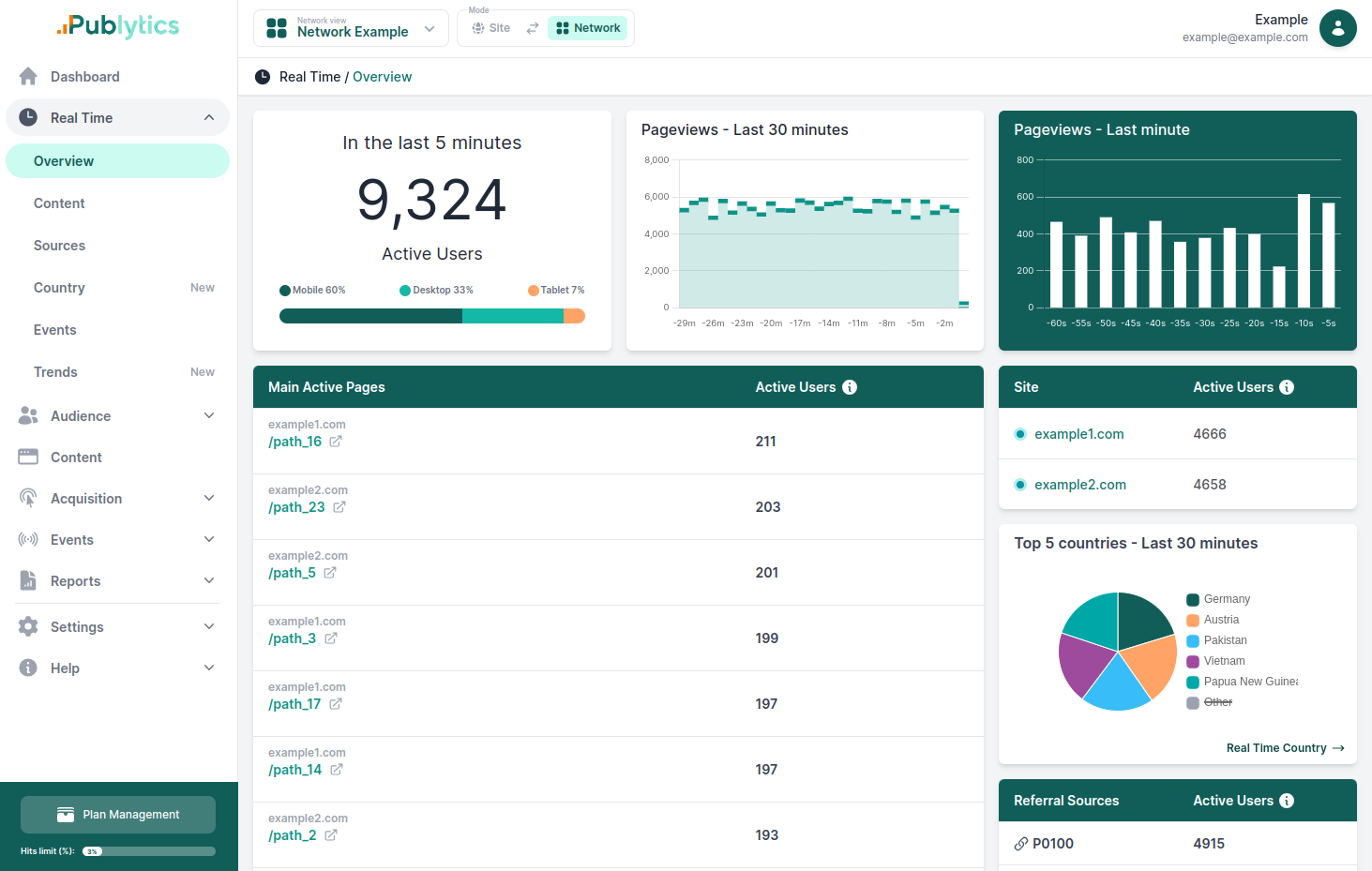
Real-time reporting made the whole thing operational. Active users, live pages, sources, devices and short-term trends were all there to check on demand, with no waiting on delayed exports or rebuilding the same view across three different tools.
"What we liked about Publytics was that it made the important signals easier to read. We could see Google traffic, AI-related visits, source-level data and page-level engagement without turning every report into a technical investigation. That clarity matters because it shortens the distance between data and action."
The results: What the analysed Publytics dataset showed
Across the analysed dataset, Publytics gave Public Image a cleaner view of how people reached the site and what they did once they arrived. The sample was large enough to be useful: 15,066 users, 15,714 sessions and 22,194 pageviews, with an 81.44% bounce rate and an average session of 46 seconds.
By source:
- - Google led comfortably with 12,384 pageviews, 55.8% of the total, about what you'd expect from a search-driven site.
- - "Not set" accounted for 6,588 pageviews (29.68%). That near-30% didn't have to stay a black box; the team could fold it into a wider source analysis and start teasing apart organic, referral, AI discovery and genuinely unknown paths.
- - AI visits came to 90 pageviews (0.41%), split between ChatGPT (72) and Gemini (18). ChatGPT also appeared on its own as a referral source, with 72 pageviews across 36 sessions and 36 users. Small, clearly, but big enough to track as its own category rather than let it dissolve into everything else.
Pages told the rest of the story. The homepage did the heavy lifting with 14,256 pageviews (64.23% of the total), an average of 1 minute 38 seconds on page and an 80.11% bounce rate, roughly what a main entry point should look like.
The service and intent pages were more revealing:
- - SEO optimisation (/seo-optimizacija/): 1,710 pageviews, 6 minutes 48 seconds average time on page, 55.56% bounce. Well under the site average, and the strongest engagement signal in the set.
- - Contact (/kontakt/): 1,368 pageviews, 3 minutes 6 seconds on page, 36.36% bounce. No confirmed conversions attached, but a clear intent pattern worth watching next to source and service-page data.
- - AI services (/vestacka-inteligencija-za-firme-srbija/): 468 pageviews, and the ChatGPT-in-Serbian content page (/chat-gpt-na-srpskom/): 72. Both small today, both worth monitoring as AI search keeps growing.
What mattered to Public Image was how these fit together. Google stayed the main visibility channel. AI visits were finally trackable on their own. The SEO service page beat the site average on engagement by a wide margin. The contact page hinted at intent worth following. And all of it lived in one workflow instead of being stitched together by hand.
What page-level data adds to source tracking
Source data shows where attention comes from and page data shows whether it amounts to anything, a contrast the homepage and the SEO optimisation page make plain: one brings the volume, the other the depth, holding visitors for minutes rather than seconds. That gap is actionable: when the team is deciding where to add internal links, expand a service explanation or point a campaign, the SEO page is the obvious candidate. The contact page adds a softer signal, since long dwell time and a low bounce point to intent worth watching, though without conversion tracking it shouldn't be read as more than that.
All of this only works when the underlying data is clean and lines up neatly with source reports, which is where Publytics earned its keep: the team could move from source to page to engagement without rebuilding the analysis each time.
How real-time analytics supports faster decisions
Sources and pages describe what's already happened; timing describes what's happening now. It's the third piece of how Publytics fits an SEO team's work, sitting alongside the source and page views the earlier sections covered. Real-time reporting often gets treated as a dashboard novelty, but its real use is more concrete: it catches a pattern while it's still forming, before a delayed aggregate flattens it out.
That immediacy matters most for an agency running client campaigns on tight schedules. When a page goes live or a campaign launches, the real-time report shows active users, live pages, sources and devices as they move, so the team can tell whether traffic is coming from the source they expected or from somewhere they didn't, and respond the same day rather than a week later. It also surfaces anomalies worth a second look, a sudden referral or a service page lighting up unexpectedly, early enough to act on them. Read next to the source and page data, that live layer is what made Publytics part of the team's daily routine rather than a report they opened now and then.
Conclusion: Why Publytics became a clearer analytics workflow for Public Image
For Public Image, the point of Publytics was readability. The team could open the reports and understand their traffic quickly, without the usual detour through raw counts and technical clean-up, which is what an agency needs when analytics has to feed real decisions on a schedule.
The dataset showed Google as the dominant channel, AI as a small but real and separately trackable signal, an SEO service page performing well above average on engagement, and a contact page worth monitoring for intent. Just as important, Publytics held those views together in a single workflow, so the team could move from source to page to real-time activity without falling back on slower, more scattered reporting.
"Publytics helps us read the data in the way an SEO team actually needs to use it. We can see where attention comes from, which pages deserve closer analysis, and which new signals are starting to appear. That makes it easier to make decisions, explain them to clients, and adapt as search changes.”
As search becomes more fragmented across Google, AI tools, referral paths and discovery surfaces, agencies need analytics that make those differences visible. For Public Image, Publytics became that clearer layer between raw traffic and practical SEO decisions.
For Public Image, Publytics made the difference between watching traffic and understanding it.
Start your 14-day free trial with Publytics here!
Recent Posts
-
Publisher metrics that actually matter in 2026
Oct 22, 2026 | Author: Anna Battistella
-
Google Quality Raters: How to tell if they visited your site
Oct 12, 2026 | Author: Anna Battistella
-
HoneyLog now supports MCP: ask your AI assistant about your traffic
Sep 30, 2026 | Author: Anna Battistella
-
Google Discover Publisher Rankings in August 2026: winners, losers, and major shifts
Sep 17, 2026 | Author: Anna Battistella
-
Google Discover Publisher Rankings in July 2026: winners, losers, and major shifts
Aug 24, 2026 | Author: Anna Battistella
Start monitoring your websites in few seconds No credit card required!
Start monitoring your websites in few seconds