



 All Post
Google Quality Raters: How to tell if they visited your site
Oct 12, 2026 | Author: Anna Battistella
Your traffic dropped after a Google update. Which articles caused it?
For publishers, few things are as unsettling as a sharp fall in Google traffic in the weeks after a core update. Search Console confirms that clicks and impressions have dropped, and it shows which pages lost the most; what it cannot show is which of those pages Google was actively examining, or when. With hundreds or thousands of pages to consider, editorial teams are often left to guess where to begin.
There is, however, a signal that most analytics setups overlook: visits from Google's Search Quality Raters. These are people who review search results, and the pages that appear in them, on Google's behalf. Their visits are few in number and easy to miss, but when they can be identified, they show which parts of a site were under evaluation and at what point in time.
In this article, we explain who Google's quality raters are and what they assess, clarify what their ratings can and cannot do to your rankings, and show how Publytics detects their visits.
What are Google Search Quality Raters?
Search Quality Raters are external evaluators who help Google measure the quality of its search results. According to Google's published overview of the programme (November, 2023), there are approximately 16,000 raters worldwide, based across North America, Latin America, EMEA and Asia-Pacific and speaking more than 80 languages between them. They are employed by third-party vendors rather than by Google itself, and they must pass a test on Google's guidelines before they are allowed to rate.
Their work forms part of a wider evaluation process. Before a change to Search is launched, Google tests it extensively: according to How Search Works, the company ran 719,326 search quality tests and 124,942 side-by-side experiments in 2023 alone. In a side-by-side experiment, raters are shown two sets of results, one with the proposed change and one without, and asked which they prefer and why. Throughout, they follow a detailed public manual, the Search Quality Rater Guidelines, most recently updated on 11 September 2025.
What raters evaluate
Raters carry out two principal types of assessment. The first, Page Quality, measures how well a page achieves its purpose, on a scale that runs from Lowest to Highest. The second, Needs Met, measures how well a result satisfies the intent behind a specific search, from Fails to Meet to Fully Meets.
When judging Page Quality, raters rely on the framework Google calls E-E-A-T: the experience, expertise, authoritativeness and trustworthiness demonstrated by the content and its creator. Of the four, the guidelines single out Trust as the most important: an untrustworthy page has low E-E-A-T, however experienced or expert its author may appear. In practice, this means examining the quality of the main content, the information available about the website and its authors, and the reputation of both.
Certain subjects are held to a higher standard. Google refers to them as YMYL, or "Your Money or Your Life": topics such as health, finance and safety, where inaccurate or low-quality information could cause real harm. On these topics, raters are asked to check that content is accurate and consistent with well-established expert consensus. For publishers working in these areas, pages are assessed against the most demanding criteria in the guidelines.
Do quality raters affect your rankings?
Not directly, and Google is consistent on this point. Its overview states that no single rating, and no single rater, directly determines how a page or site ranks in Search. Ratings are instead taken in aggregate to measure how well Google's algorithms are performing, and to provide its systems with examples of good and poor results. In its guidance on helpful content, Google compares rater input to the feedback cards a restaurant collects from its diners. Raters also cannot penalise a site: manual actions are a separate process, carried out by Google's own reviewers and reported in Search Console.
This does not make rater visits irrelevant. A visit indicates that a page was included in a sample of results Google chose to evaluate, often during periods when it is assessing changes to its ranking systems. Knowing which pages were reviewed, and when, does not explain a ranking change on its own, but it provides a well-founded starting point for analysis, particularly when those visits coincide with a core update. The reverse does not hold, however: not every rating task requires opening every result, so an absence of rater visits does not prove that a site was not evaluated.
How to tell if a quality rater has visited your site
Raters perform their tasks through Google's rating platform, RaterHub. When a rater opens one of your pages as part of a task, the visit can arrive with a RaterHub referral, and this is the trace that makes rater activity identifiable in your data.
The difficulty lies in scale. A rater review typically amounts to a handful of visits, often fewer than ten, among tens or hundreds of thousands of pageviews. Analytics tools that sample data, or that estimate figures when volumes are low, can easily obscure them. If a report is built from a subset of sessions, a single rater visit may never appear in it at all.
We have previously examined the effects of data sampling in our case study on how Money.it eliminated data sampling, and in our analysis of why user figures in GA4 often fail to add up. Where quality raters are concerned, the implications are the same: if not every visit is recorded, the few that matter most are the likeliest to be lost.
Reliable detection therefore depends on four conditions: complete, unsampled data, so that every visit is counted; retention long enough to compare one update with the next; visibility of the exact page each rater opened; and a timeline that can be compared directly with Google's confirmed updates.
How Publytics identifies quality rater visits
Publytics does not sample data. Every pageview is recorded and counted, including the small number that originate from Google's quality raters, which is what makes those visits visible in the first place.
Rater activity is gathered in a dedicated report, found under Events → Google Quality Raters. Its main chart, Quality Raters vs Google Views, plots daily pageviews from Google sources alongside the number of rater hits over the same period. With the Google updates & Annotations option enabled, Google's confirmed ranking updates are marked on the same timeline. Beneath the chart, a table lists each page that raters opened, together with the number of hits it received and the total for the selected period.
Taken together, these elements answer three questions that Search Console cannot: when raters reviewed the site, which articles they opened, and how Google traffic to those articles changed before and after.
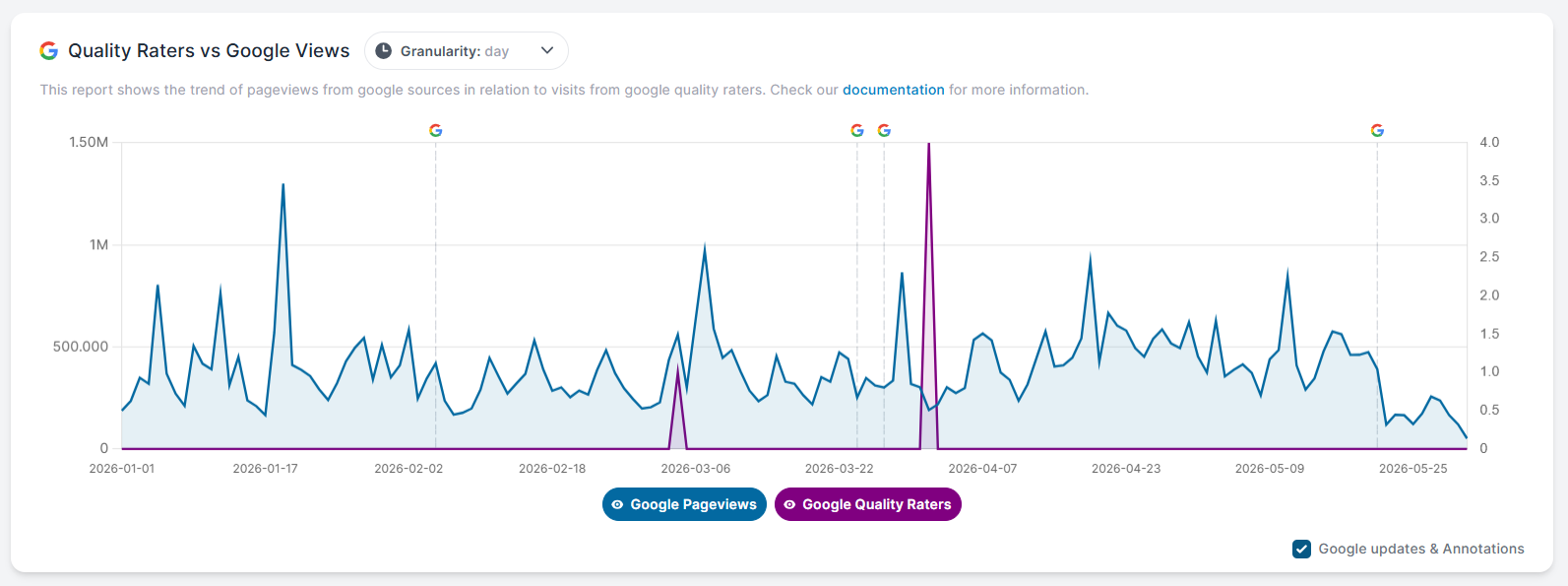
The Google Quality Raters report in Publytics.
Case study: a newsroom after the May 2026 core update
The publisher in this case is a mid-sized Italian website covering economics and personal finance, a subject area that falls squarely within Google's YMYL category. Over the period examined, from early June to the end of July 2026, the site lost more than 90% of its traffic from Google. The Google Quality Raters report recorded 14 rater visits during the same period.
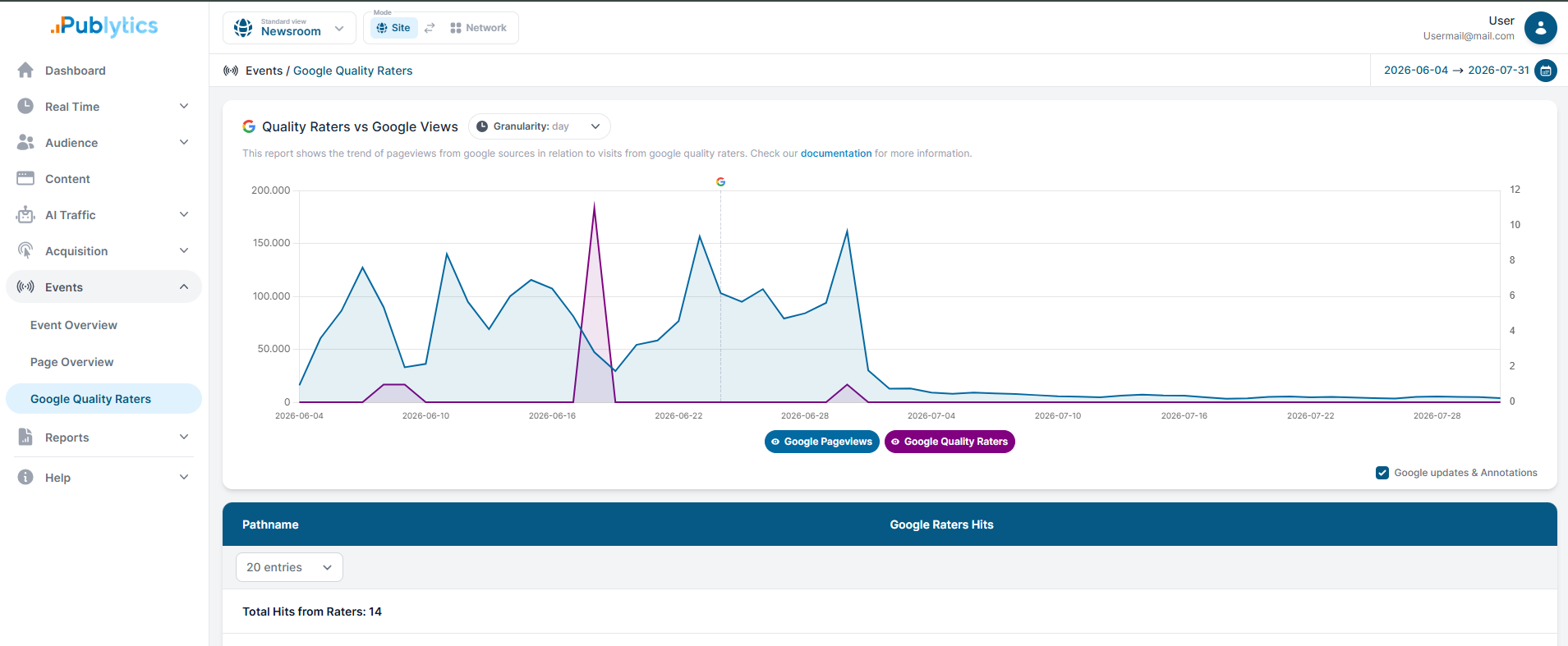
Google pageviews and quality rater hits.
The sequence of events, set against the update dates published on Google's Search Status Dashboard, was as follows:
| Date (2026) | Event |
|---|---|
| 21 May – 2 June | The May 2026 core update rolls out |
| 7–8 June | The first two rater visits are recorded, one on each day |
| 17 June | Eleven rater visits are recorded in a single day, the largest concentration of the period |
| 22 June | Google traffic recovers to approximately 155,000 daily pageviews |
| 24–26 June | The June 2026 spam update rolls out |
| 30 June | A final rater visit is recorded; Google traffic peaks at approximately 160,000 pageviews |
| From 1 July | Google traffic falls to approximately 30,000 pageviews on 1 July and settles at around 5,000 per day for the rest of the month |
Reading the data
Three patterns stand out. First, every rater visit occurred after the May core update had finished rolling out, during a period in which Google was evidently still evaluating results in this area. Second, rater attention was highly concentrated: 11 of the 14 visits took place on a single day, 17 June, which suggests that several of the site's pages formed part of the same evaluation. Third, the collapse in traffic began within a day of the final rater visit, and only a few days after the June spam update had completed.
It is important to be precise about what this shows. The data does not demonstrate that raters caused the decline; as Google makes clear, individual ratings do not move rankings. What it does show is that the period of heaviest rater activity sat between two confirmed updates and immediately preceded the loss of traffic. For a publisher trying to understand what happened, that narrows the field considerably.
Rather than auditing the entire archive, the analysis could begin with the specific pages listed in the report, comparing each one's Google traffic before and after the updates and reviewing it against the criteria set out in the rater guidelines.
What to do if quality raters have visited your pages
A rater visit should be treated as an indicator of where to look, not as a verdict. The steps below draw on Google's own guidance on core updates and on creating helpful, reliable, people-first content.
- Start with the pages raters opened. Use the list of visited pages, ordered by number of hits, as the first set of candidates for review.
- Compare performance over the right periods. Google recommends waiting at least a full week after an update has finished before analysing its effects, and then comparing that week with one before the rollout began. Assess each page individually rather than relying on site-wide totals.
- Review content against Google's self-assessment questions. Consider who created each page, how it was produced and why it exists. For YMYL topics such as finance, factual accuracy and demonstrable expertise carry particular weight.
- Make authorship clear and verifiable. Articles should carry a byline that links to an author page with relevant background. Google explicitly identifies fabricated author profiles as a form of deception.
- Improve rather than remove. Google cautions against quick fixes and describes deleting content as a last resort. Updating, restructuring and adding original analysis are generally more effective responses.
Recovery, where it happens, is rarely immediate. Google notes that some improvements may take several months to be reflected, and in some cases only become visible after a subsequent core update. Monitoring rater activity during that period, alongside page-level traffic, helps confirm whether the pages under review are being reassessed. For broader guidance on underperforming content, see our article on why website posts are not getting views.
Conclusion
Quality raters do not decide where your pages rank, but their visits offer a rare view into which parts of a site Google is examining and when. For publishers dealing with the aftermath of a core update, that information can turn an open-ended investigation into a focused, page-by-page review.
Capturing it, however, requires analytics that record every visit. Publytics measures all traffic without sampling, places quality rater activity alongside Google pageviews and confirmed algorithm updates, and does so with a lightweight, cookieless script that does not affect site performance.
Start your 14-day free trial of Publytics. No credit card is required.
Recent Posts
-
Google Quality Raters: How to tell if they visited your site
Oct 12, 2026 | Author: Anna Battistella
-
HoneyLog now supports MCP: ask your AI assistant about your traffic
Sep 30, 2026 | Author: Anna Battistella
-
Google Discover Publisher Rankings in August 2026: winners, losers, and major shifts
Sep 17, 2026 | Author: Anna Battistella
-
Google Discover Publisher Rankings in July 2026: winners, losers, and major shifts
Aug 24, 2026 | Author: Anna Battistella
-
Google Discover Publisher Rankings in June 2026: winners, losers, and major shifts
Jul 21, 2026 | Author: Anna Battistella
Start monitoring your websites in few seconds No credit card required!
Start monitoring your websites in few seconds